What is an oscillating vibration plate?
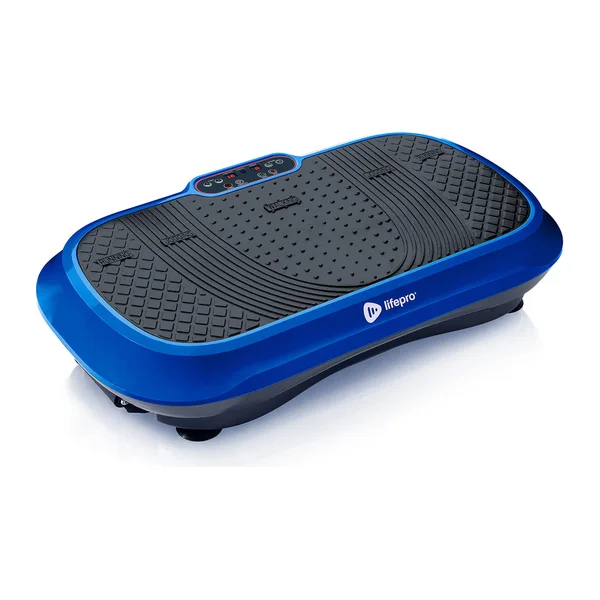
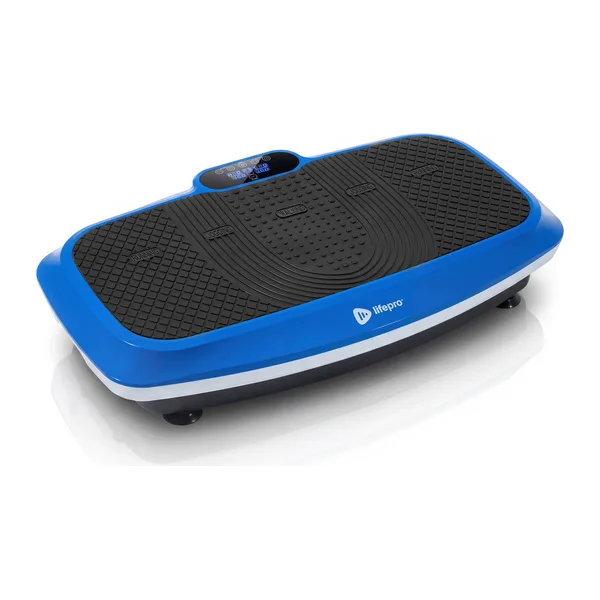
Picture a seesaw seen from the front. The deck pivots around a center axis: when the left side goes up, the right side goes down. Your hips shift a little with each tilt, a bit like walking in place. This is the type you see in most living rooms, and almost every plate under $200 works this way. Hypervibe and Sunny call it pivotal; LifePro and Merach say oscillating. Same thing.
Two details matter. First, these plates run slowly: the LifePro Waver lists 4 to 12 Hz, the Merach CV40 7 to 9.6 Hz. Second, the movement is large and depends on where you stand. LifePro gives 0 to 8 mm for the Waver: near zero with your feet at the center, the full 8 mm at the edges. Sunny lists 15.8 mm for its Fitboard. So you have two dials on an oscillating plate: the speed button, and how wide you place your feet.
What is a linear (vertical) vibration plate?
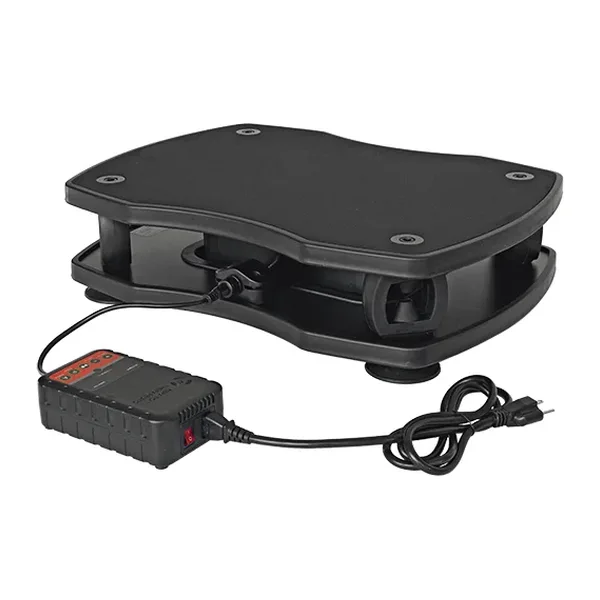
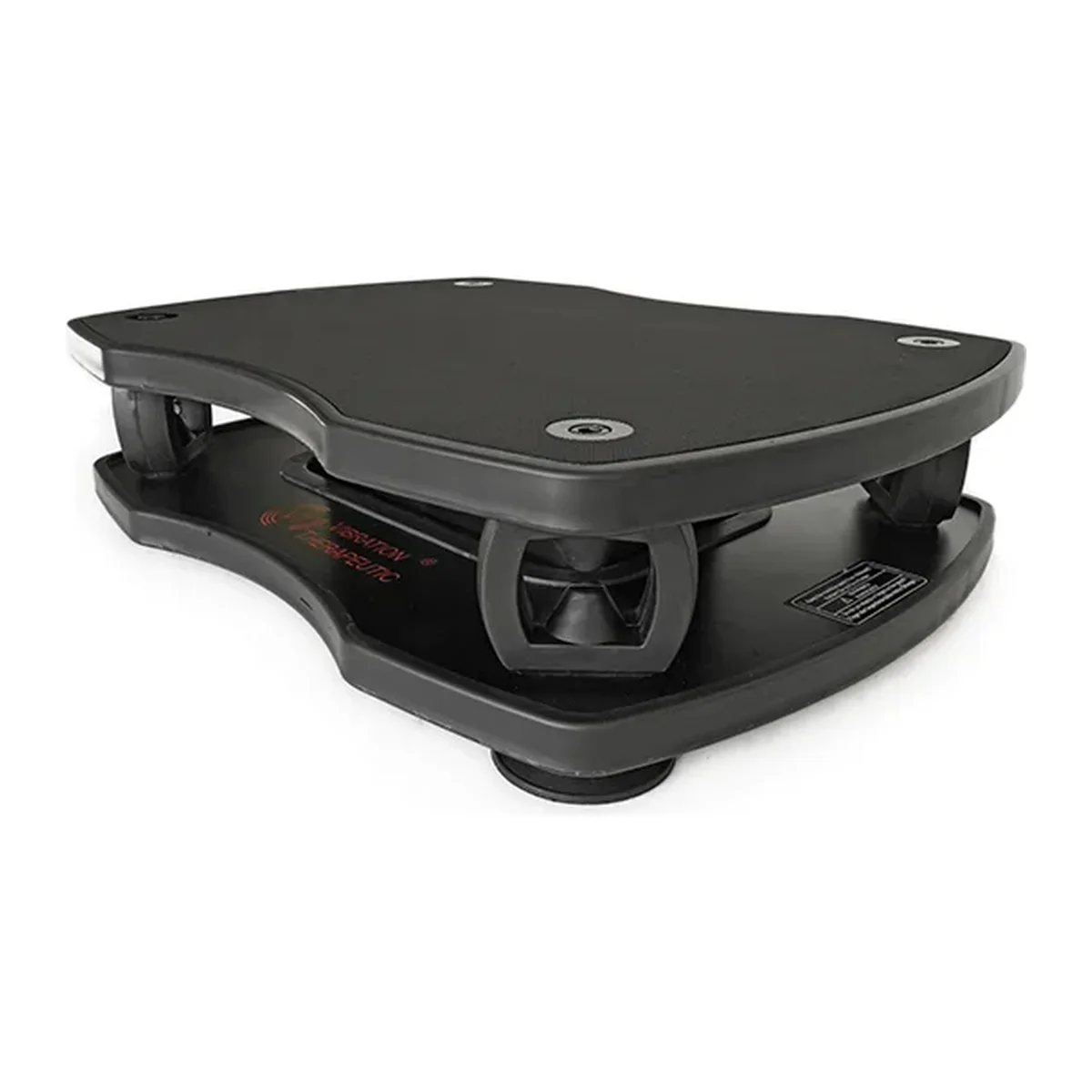
Here the whole deck goes up and down together, flat. There is no tilt and no center axis, so it doesn't matter much where your feet are. The movement is small and quick. The VT007 from Vibration Therapeutic runs from 10 to 40 Hz in 1 Hz steps, with 0.7 to 1.2 mm of travel on its low setting and 1.5 to 2.6 mm on high, measured without a user, per the brand. You feel a hum through your feet more than a rock.
Power Plate sits next door. It calls its motion tri-planar: the deck vibrates in three directions at once, again fast and small. The Power Plate MOVE runs at 30 to 40 Hz; the Personal Power Plate is fixed at 35 Hz. Power Plate gives two amplitude settings, Low and High, and no millimeter figure. This is the family you meet in gyms and physical therapy rooms, and the reason it costs what it costs is covered in Power Plate vs a regular vibration plate.
How different do they feel?
Very. At a low speed, an oscillating plate is a slow rock you can stand on while you brush your teeth. It is the gentler introduction, which is why brands that sell to beginners build this type. Turn it up and the rock becomes a brisk shake, but it never turns into a buzz.
A linear or tri-planar plate at 30 Hz is a buzz from the first second. Most people keep their knees soft and hold a position (a half squat, a calf stretch, a plank with palms on the deck) for 30 or 60 seconds at a time. The Personal Power Plate's timer only offers those two durations, which tells you how the brand expects it to be used. Neither feeling is better. They are just not interchangeable, and it is the first thing to settle before you compare prices. The video below, from Hypervibe (which sells pivotal machines, so take its preference with that in mind), shows both movements side by side.
Video: "Pivotal Or Lineal - Which One Is Best For Your Body", Hypervibe US on YouTube. Not made by us; chosen because it shows the plate or the topic clearly.
What do 3D and 4D mean on a vibration plate?
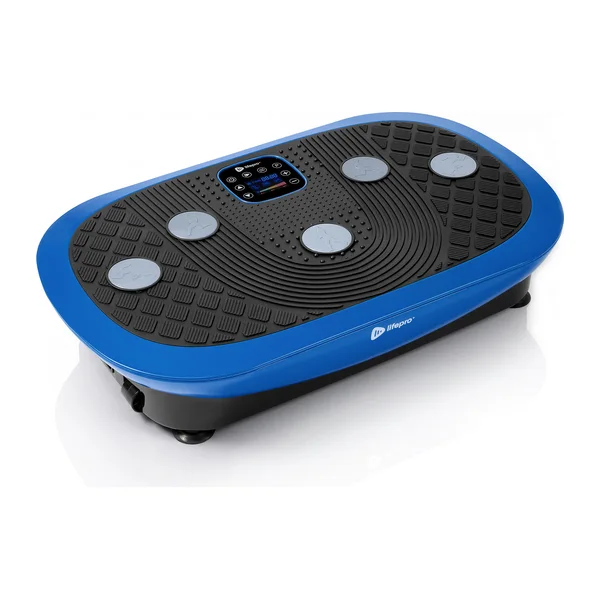
Extra motors, mostly. There is no standard behind the letters, so read the list of movements instead. The LifePro Turbo 3D has two motors: one for oscillation, one for a quicker pulsation, alone or combined, from 4 to 15 Hz. The LifePro Rumblex Plus 4D has three: oscillation, a lateral side-to-side movement (1.5 mm) and pulsation (8 mm), from 4 to 40 Hz over 60 speed levels.
What you gain is range. A 4D plate does the slow seesaw of a basic model and also reaches the fast end where linear plates live, even if the movement is not identical. What you should not assume is that more D's means more benefit: no source we read ranks one motion above another for results. And some labels are looser than others. Eilison sells its FitMax as "3D", while its manual lists the movement as "Pivot (Up & Down)". That is why our comparison tables show the vibration type in plain words and the frequency in hertz, not the marketing letter.
Which type for which goal?
For ten gentle minutes a day, or if this is your first plate: oscillating. It is easy to stand on, cheap, and the low end is slow. Our ranking of plates under $150 is made of this type only.
For exercising on the deck (squats, lunges, planks): look at the range before the type. You want room to go from slow to fast as you get used to it, which today points to a multi-motor plate. See the plates built for real exercise.
For questions about balance or bone density: this is where your doctor comes first. The Mayo Clinic says some research shows whole-body vibration can improve strength and balance in older adults and reduce bone loss "when performed correctly and under medical supervision when needed", and that thorough research is still lacking. No source we read tells a home buyer which type to choose for that. What we can say is which brands publish numbers a clinician can read: that is the idea behind our ranking for seniors.
Which numbers should you compare?
Three, in this order. Frequency, in hertz: how many times a second the deck moves. A range (4 to 40 Hz) is worth more than a single top figure, because the low end is what you will use on tired days. Amplitude, in millimeters: how far it travels. Check whether the brand gives it at the edge of the deck or as an average, and whether it was measured with someone standing on it. Vibration Therapeutic is the only brand in our comparison that publishes both loaded and unloaded figures.
G-force comes last, and with care. Hypervibe says its G10 Mini reaches 10 g; VT lists 3.3 g without load for the VT007 and 2.7 g with a 180 lb user. Those figures are each brand's own, measured its own way, so do not rank one against the other. Most budget brands publish no G-force at all. In our formula a plate earns points for each number its maker puts in writing, and nothing for adjectives.
What does each type cost?
On November 12, 2026, on each brand's own US store: a compact oscillating plate starts at $119.99 (Merach CV30 Pro) and a full-size one costs $199.99 (LifePro Waver). Two motors: $249.99 for the Turbo 3D. Three motors: $399.99 for the Rumblex Plus 4D. Linear: $479.99 for the VT007, with a 90-day return that VT pays for in the 48 contiguous states.
Then there is a gap. Premium pivotal machines start at $1,439.20 plus $75 shipping (Hypervibe G10 Mini), and tri-planar plates at $1,721.25 (Personal Power Plate). Both prices were Black Friday offers on the day we read them. You do not need to cross that gap to own a good plate; you cross it for a specific motion, a brand you know from the gym, or an app with coached programs.
So which one should you buy?
If you are still unsure after all this, that is an answer in itself: buy oscillating, spend little, and see whether the habit sticks. The Waver is our pick for that, with a lifetime warranty behind it. If you already know you want the fast, small vibration and you like having the numbers in writing, the VT007 is the sensible linear choice, and its return terms let you change your mind. If you want one machine that covers both ends, the Rumblex Plus 4D leads our overall ranking for exactly that reason. The head-to-head Rumblex 4D vs Waver shows what the extra motors change, line by line.
The plates in this guide, side by side
4 plates in this table: scroll sideways to see them all
| Plate | ||||
|---|---|---|---|---|
| Vibration type | Oscillating | 3D (2 motors) | 4D (3 motors) | Linear (vertical) |
| Frequency | 4–12 Hz | 4–15 Hz | 4–40 Hz | 10–40 Hz |
| Amplitude | 0–8 mm | 0–10 mm | 0–12 mm | Up to 2.6 mm |
| Max user weight | 330 lb | 330 lb | 500 lb | 250 lb |
| Platform | 27.6 × 15.7 in | 30.3 × 17.3 in | 29.4 × 17.7 in | 22 × 16.5 in |
| Motor | 200 W | 240 W (2 motors) | 640 W (3 motors) | 80 W |
| Warranty | Lifetime | Lifetime | Lifetime | 10-year |
| Returns | 30 days, unopened only | 30 days, unopened only | 30 days, unopened only | 90 days |
| Where to buy | Check price at LifePro | Check price at LifePro | Check price at LifePro | Check price at VT |
✓ marks the best figure of the row. Prices checked November 12, 2026 on each brand's own US store.
This guide helps you buy; it isn't medical advice. Whole-body vibration can be harmful in some situations: check with your doctor before using a plate, especially if you are pregnant or have any health problems.